

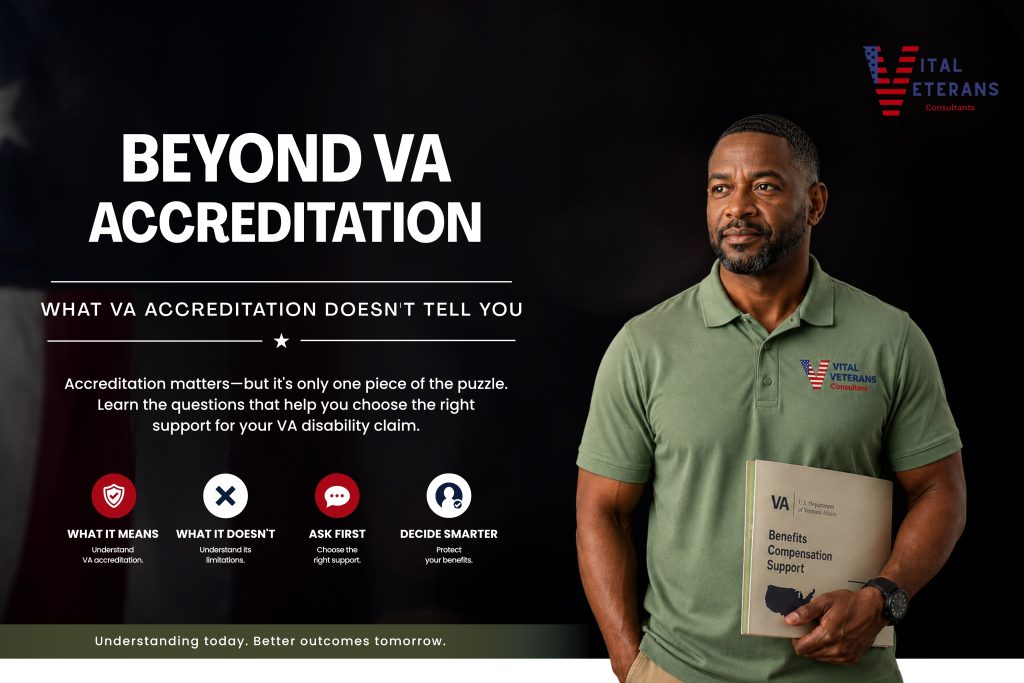
When you start researching help with a VA disability claim, one phrase gets repeated so often it almost sounds like law:
“Only work with someone who is VA accredited.”
And here’s the thing — that’s not wrong. VA accreditation exists for real reasons. It sets standards. It creates accountability. It helps protect veterans from bad actors who have, throughout history, tried to profit from people who were just trying to collect what they earned.
But there’s a question buried underneath that advice that almost nobody asks:
Does accreditation alone tell you whether someone will actually help you — or just whether they’ve cleared a bureaucratic threshold?
Because those are two very different things. And veterans deserve to understand the difference.
What Is VA Accreditation? The Actual Definition
VA accreditation is federal authorization issued by the VA’s Office of General Counsel (OGC) that allows specific individuals to formally assist veterans in reparing,
presenting, and prosecuting VA benefit claims.
There are three types of accredited representatives:
1. VSO Representatives
Representatives working for a VA-recognized Veterans Service Organization (VSO) — organizations like the DAV, VFW, or American Legion. To become accredited, the VSO must recommend the representative to the OGC and certify that they possess good character and are fit to represent veterans. VSOs generally provide their services at no charge to veterans.
2. VA-Accredited Claims Agents
Non-attorneys who have passed a written VA examination (requiring a score of 75% or higher), cleared character and fitness requirements, and maintained continuing legal education (CLE) requirements. Claims agent applications take approximately one year to process due to background investigations required by the OGC. They may charge fees, but only for appeals after an initial VA decision — not for preparing the original claim.
3. VA-Accredited Attorneys
Licensed attorneys who are in good standing with at least one state bar, have cleared VA’s character and fitness review, and completed required CLE in veterans’ benefits law. Attorney applications typically take 60–120 days. Like claims agents, they may charge fees only after an initial VA decision, often structured as a percentage of retroactive back pay.
The accreditation system is administered by the VA’s Office of General Counsel, which functions similarly to a state bar association — making initial accreditation determinations, monitoring conduct, investigating complaints, handling fee disputes, and revoking accreditation when necessary. Those are meaningful safeguards.
But they answer one specific question: is this person authorized to formally represent a claimant before the VA? They do not answer the questions veterans often need answered most.
What VA Accreditation Does — and Doesn’t — Tell You
Think about other credentialed professions. A medical license doesn’t tell you which doctor will spend the most time listening to your symptoms. Passing the bar doesn’t tell you which attorney returns calls fastest. A CPA license doesn’t tell you which accountant will catch the deductions others miss. Credentials establish a floor. They don’t tell you much about the ceiling — and they tell you almost nothing about who will build you the strongest possible claim. VA accreditation tells you that someone met a threshold requirement to formally represent claimants. It does not automatically answer:
- How experienced are they with claims like mine?
- How many cases are they managing simultaneously?
- How long will it take to get an appointment?
- Will they proactively identify secondary conditions I haven’t filed?
- Will they explain the process clearly, or just handle paperwork?
- How do they communicate throughout — and how responsive are they?
- What does their track record with outcomes actually look like?
- How are their fees structured, and what am I agreeing to?
Those questions are about service quality, preparation depth, and alignment of incentives. They’re the questions that actually predict whether a veteran gets the
outcome they deserve. Accreditation doesn’t answer them. Due diligence does.
Why VA Accreditation Was Created — and Why the System Has Evolved
The origins of VA accreditation stretch back to the Civil War era. Congress recognized that certain individuals were exploiting veterans by charging excessive fees to help obtain benefits that had already been earned through military service. To stop this, lawmakers created restrictions on who could assist with claims and how fees could be charged. Those protections were necessary then, and the core principle behind them — protecting veterans from exploitation — remains valid today. But the VA disability system of 2026 looks almost nothing like the one Congress envisioned more than a century ago. Today’s veterans navigate:
- Complex C&P exam processes and Disability Benefits Questionnaires (DBQs)
- Secondary and presumptive service connection arguments
- Combined-rating calculations that don’t follow normal math
- Supplemental claims, Higher-Level Reviews, and Board of Veterans’ Appeals pathways
- Constantly evolving regulations — including major changes from the PACT Act (2022)
- Nexus letter requirements and independent medical evidence strategy
As the system has grown more complex, veterans have naturally sought different types of support for different parts of the process. Accreditation governs formal representation before the VA. Education, preparation, documentation strategy, and claim building are a different set of functions — functions that consulting organizations provide legally and that millions of veterans use to navigate the system more effectively.
The question isn’t whether accreditation matters. It does. The question is whether it’s the only factor that matters when evaluating who helps a veteran navigate one of the most complex bureaucratic systems in the country.
The Real Performance Picture: What the Data Says About Outcomes
Here’s where the conversation gets genuinely interesting — because the data is more nuanced than most people expect.
According to the Board of Veterans’ Appeals FY 2024 Annual Report, appeal outcomes vary significantly based on representation type:
42.7% appeal approval rate for attorney-represented veterans at the BVA vs. 29.7% for
unrepresented veterans
12.7% denial rate for attorney-represented claims at the BVA vs. 21.2% for unrepresented
veterans
30–32% approval range for most VSO-represented claims at the BVA solid, but ~10–12
points below attorneys
The data supports a clear conclusion: having representation helps. Specifically, having experienced, well-prepared representation makes a measurable difference in outcomes.
But look closer at what those numbers are actually measuring. BVA appeals data captures formal legal representation at the appeals stage — after an initial claim has already been decided. It doesn’t capture what happened during the original claim build.It doesn’t tell you about claims that were approved on the first submission because they were built correctly from the start.
That’s where preparation — the work that happens before the VA ever sees the claim — becomes the variable that matters most.
The best outcome is a fresh claim built on solid medical evidence and informed strategy that doesn’t need an appeal. Strong claim construction at the front end reduces the need for expensive legal representation at the back end.
The Honest Truth About VSOs: Incredible Mission, Real Capacity Challenges
Veterans Service Organizations have served this country’s veterans faithfully for generations. Organizations like the DAV, VFW, American Legion, and state and county veterans offices have helped millions of veterans file claims. Their work deserves genuine respect.
But respecting their mission doesn’t require pretending capacity challenges don’t exist. And they do.
Some VSO representatives, particularly in under-resourced areas, manage hundreds or even thousands of active cases simultaneously. Appointments can be booked months out. Response times vary significantly. Staffing depends on membership dues, donations, and government budgets that fluctuate with economic and political conditions.
As one veterans advocacy resource bluntly stated: many VSOs are overworked and underpaid, some are part-time employees responsible for serving an entire military base, and it can be difficult to get an appointment as some are booked out months in advance.
Recognizing those realities isn’t criticism of VSOs. It’s acknowledging the gap between an admirable mission and the resources available to execute it.
That gap — between what veterans need and what a free, high-volume system can deliver — is exactly the space where additional support structures have a legitimate role to play.
Veterans who get the most from the system are often those who arrive best prepared — with clear documentation, strong medical evidence, and a well-organized claim. Preparation is not competition with VSOs. It’s what makes their job easier.
VSO vs. Accredited Attorney vs. Consulting Organization: A Clear-Eyed Comparison
Every veteran’s situation is different. Understanding how each type of support works — and where each fits best — helps veterans make informed choices:
| FACTOR | VSO | REPRESENTATIVE | ACCREDITED ATTORNEY | CLAIM CONSULTANT |
|---|---|---|---|---|
| Cost | Free (no fee) |
% of back pay (often 20–33%) |
% of back pay (appeals) Fee tied to increase |
(4x monthly increase) |
| When involved | Any stage | Primarily appeals | Fresh & initial claims | |
| Formal VA representation | Yes | Yes | No | |
| Caseload | Often very high | Varies | Typically lower | |
| Focus | Representation | Legal arguments | Medical evidence & strategy | |
| Best for | All veterans | Complex appeals | Fresh claims built to win |
The honest answer is that these aren’t mutually exclusive. Veterans can — and often should — use more than one type of support at different stages of the process. A consulting organization that builds a strong initial claim can make a VSO’s job easier. An accredited attorney who handles a complex appeal benefits from a well-documented foundation.
The smartest approach isn’t picking a lane. It’s understanding what each option does well and using them strategically.
On Fear, “Don’t Poke the Bear,” and Informed Decision-Making
No conversation about VA disability claim assistance is complete without addressing the phrase veterans hear most often:
“Don’t poke the bear.”
The concern is that filing for an increase could trigger a review of an existing rating, resulting in a reduction. Veterans should understand that possibility is real — not so they can be paralyzed by it, but so they can make informed decisions.
What the “don’t poke the bear” framing misses is this: ratings that have been in place for five or more years carry significant legal protections. The VA must demonstrate sustained improvement in a veteran’s condition — across typical daily life, not just a single exam — before reducing a protected rating. Filing a new claim for an additional or secondary condition does not automatically trigger a review of existing ratings.
Fear-based inaction has a real cost. For a veteran sitting at 90% who qualifies for 100%, that fear is worth approximately $18,900 per year in foregone compensation — every single year.
Beyond accreditation means going beyond fear. It means asking informed questions, evaluating evidence honestly, and making decisions based on your actual circumstances rather than blanket caution passed from one veteran to another without context.
The Questions Veterans Should Actually Ask Before Choosing Help
Instead of asking only “Are they accredited?” — which tells you about one threshold requirement — consider asking:
About Experience
- How long have you been working with VA disability claims specifically?
- How familiar are you with claims involving my type of service-connected
conditions? - Can you explain secondary conditions and how they apply to my situation?
About Process
- What does your claim-building process actually look like, step by step?
- Will you help me understand what evidence I need and why?
- How do you handle the C&P exam preparation process?
About Communication
- How will you keep me informed throughout the process?
- What’s the typical response time when I have a question?
- Will I have a consistent point of contact who knows my case?
About Fees and Alignment
- How are you compensated, and when?
- Is your compensation tied to my outcome, or do you collect regardless of results?
- Are there any fees I could owe even if my claim isn’t successful?
About Results
- What outcomes do your clients typically experience?
- Do you have testimonials or reviews from veterans you’ve worked with?
- Can you explain what success looks like and what the realistic range of outcomes
might be?
Those questions will tell you far more than a credential alone.
How Vital Veterans Consultants Fits Into This Picture
Let’s be direct about what we do — because it’s more than strategy sessions and paperwork tips.
At Vital Veterans Consultants, we build fresh VA disability claims from the ground up. That means we don’t just hand a veteran a checklist and wish them luck. We work alongside veterans to develop the medical evidence, identify the right conditions to file, establish service connections that hold up, and construct a complete claim built with informed strategy from day one.
Medical evidence is at the center of everything we do. A claim without the right evidence doesn’t just get denied — it sets a veteran back months or years. Our job is to make sure that never happens by ensuring the medical picture is complete, accurate, and clearly connected to service before the claim ever reaches the VA.
That’s what separates a well-built fresh claim from one that’s patched together and hoping for the best. And that’s where our expertise sits.
Here’s what that looks like in practice:
- Comprehensive review of service history and medical records to identify every condition worth filing
- Identification of secondary conditions caused or aggravated by already-approved disabilities
- Coordination of medical evidence that clearly establishes the nexus between service and condition
- Informed claim strategy — built around what the VA actually needs to see, not guesswork
- Support through every step so the veteran understands the process and what’s happening with their case
We are not accredited representatives. We do not formally represent veterans before the VA. But we build the kind of fresh, medically grounded claims that give veterans the strongest possible foundation going in — and that’s the part of the process that determines most outcomes. Our compensation model is straightforward and fully aligned with your result:
- No upfront fees — ever
- We charge 4x the monthly benefit increase we help a veteran secure
- If there is no increase, there is no charge
- Veterans pay monthly or spread over a five-month period
- No percentage of back pay. No lifetime obligations. No hidden fees.
We actively encourage veterans to work with VSOs. We refer veterans to them and help veterans arrive better prepared. A fresh claim built on solid medical evidence and informed strategy makes everyone’s job easier — including the VSO’s.
We don’t just advise veterans on strategy. We build the claim — with medical evidence, informed filing decisions, and the kind of preparation that gives a fresh claim a real chance the first time through.
Frequently Asked Questions About VA Accreditation
What is VA accreditation and who issues it?
VA accreditation is federal authorization issued by the VA’s Office of General Counsel (OGC) that allows specific individuals to formally prepare, present, and prosecute VA benefit claims on behalf of veterans. There are three types: VSO representatives, VA-accredited claims agents, and VA-accredited attorneys. Each type has different requirements, fees structures, and roles in the claims process.
What’s the difference between a VSO and a VA-accredited claims agent?
A VSO representative works for a VA-recognized Veterans Service Organization and provides assistance at no charge to veterans. They are recommended by their organization and accredited by the OGC. A VA-accredited claims agent is an individual who passed a written VA exam (75%+ required), cleared character and fitness requirements, and completed continuing education requirements. Claims agents may charge fees for appeals-related work but must be approved by the VA to do so.
Is it illegal for a non-accredited organization to help veterans with VA claims?
No — and this distinction is important. What is restricted by law is formal representation before the VA without accreditation — meaning filing claims on a
veteran’s behalf, accessing VA systems on their behalf, or prosecuting claims as their legal representative. Education, consulting, preparation support, documentation organization, and claim strategy guidance are separate functions that are legally provided by non-accredited organizations. Federal courts have also examined whether certain consulting activities constitute protected speech under the First Amendment.
Do accredited representatives produce better claim outcomes?
Data from the Board of Veterans’ Appeals shows that attorney-represented claims have higher approval rates at the appeals stage — 42.7% vs. 29.7% for unrepresented veterans. However, this data is specific to formal appeals before the BVA, not the initial claim process. Strong preparation at the initial claim stage can prevent the need for appeals entirely. The best outcomes often come from well-prepared first submissions combined with experienced support throughout.
What should I actually look for when choosing VA disability claim help?
Look beyond the credential and evaluate experience, communication, process transparency, fee structure, and alignment of incentives. Ask how they’re
compensated (and whether that compensation depends on your outcome), how many cases they handle at once, how they’ll keep you informed, and what their track record looks like. Accreditation is a useful baseline, but preparation depth, responsiveness, and outcomes tell you far more about whether someone will actually help you.
The Bottom Line
VA accreditation is valuable. It establishes standards, protects veterans from fraud, and creates accountability for formal representation. Every veteran should understand what it means and why it exists.
But accreditation is not the same as expertise in building a strong fresh claim. It doesn’t tell you who will gather the right medical evidence, who will identify every condition worth filing, or who will construct the claim with the kind of informed strategy that holds up when the VA reviews it.
The veterans who get the best outcomes are the ones who ask all the right questions — about credentials, yes, but also about medical evidence, claim construction, secondary conditions, service connection strategy, and what the process actually looks like from start to finish.
