

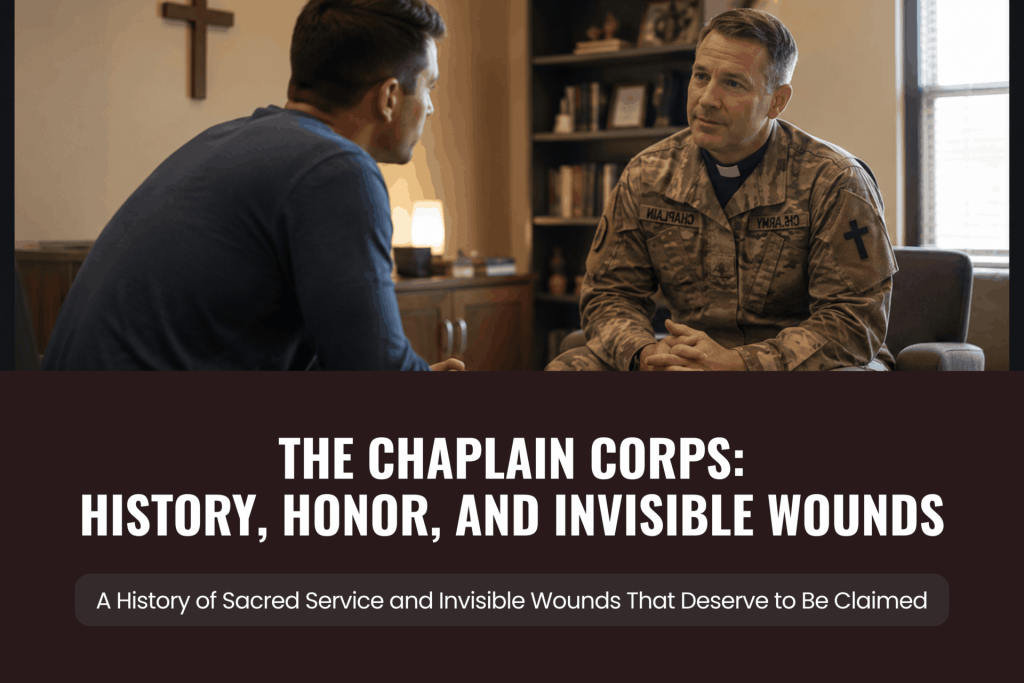
250 years of walking into the fire unarmed — and why chaplains and other noncombatants can still qualify for VA disability.
They carry no weapon. Under the Geneva Conventions, they aren’t permitted to. And yet, for two hundred and fifty years, they have walked into the same fire as the men and women they serve — not to fight, but to make sure no one faces what’s coming, or what already happened, alone.
This is the story of the military Chaplain Corps. And it’s also a message to every chaplain who has ever quietly carried more than they let on: what happened to you counts too.
A Calling Older Than the Country Itself
Military chaplaincy in America didn’t wait for independence. It was written into the earliest regulations of the forces that would become the United States military.
On July 29, 1775, the Continental Congress authorized one chaplain for every regiment of the Continental Army — the birth of the Army Chaplain Corps, predating the Declaration of Independence by nearly a year. Four months later, on November 28, 1775, the second article of the newly adopted Navy Regulations directed that “divine services be performed twice a day on board and a sermon preached on Sundays” — the founding moment of what became the Navy Chaplain Corps, which today also provides chaplains to the Marine Corps and the Coast Guard.
Nearly two centuries later, when the Air Force became its own branch in 1947, it initially shared chaplains with the Army. That changed on May 10, 1949, when General Carl Spaatz ordered the creation of a separate Air Force chaplaincy, with Chaplain Charles I. Carpenter becoming its first Chief of Chaplains.
Three branches. Three founding moments, decades or centuries apart. One unbroken calling: to walk beside service members through the worst of what war and military life can bring — armed with nothing but faith, presence, and an unwillingness to let anyone face it alone.
Special Dates Worth Marking
A few dates carry particular weight for the Chaplain Corps and the people who love them:
Key Chaplain Corps Dates
July 29 Army Chaplain Corps Birthday — 1775 Continental Congress authorization
November 28 Navy Chaplain Corps Birthday — 1775 Navy Regulations, also covers Marine Corps and Coast Guard chaplains
May 10 Air Force Chaplain Corps founding — 1949 order separating it from the Army
February 3 Four Chaplains Day — nationally observed since 1988
February 3, 1943: The Four Chaplains
If there is one story that defines what it means to wear the chaplain’s insignia, it happened in the frigid waters of the North Atlantic.
On the night of February 2 into February 3, 1943, the USAT Dorchester was crossing toward Greenland carrying more than 900 servicemen, merchant seamen, and civilian workers when a German U-boat torpedo struck her engine room. Power failed instantly. Panic spread through the ship as it began to sink in the icy Labrador Sea.
Four Army chaplains — Lieutenant George Fox (Methodist), Lieutenant Alexander Goode (Rabbi), Lieutenant John Washington (Catholic priest), and Lieutenant Clark Poling (Dutch Reformed) — moved through the chaos calming the frightened, guiding men to lifeboats, and handing out life jackets. When the supply of life jackets ran out, each of the four chaplains removed his own and gave it to a soldier who had none. Survivors reported seeing the four men, arms linked, praying together in different faiths as the ship went under. The Dorchester sank in twenty minutes. Of the roughly 902 aboard, more than 670 were lost — one of the worst single losses of any American convoy in the war.
Because the Medal of Honor’s strict requirements call for heroism performed under enemy fire, Congress instead created a one-time-only decoration: the Four Chaplains’ Medal, authorized in 1960 and presented to their families in 1961. It has never been awarded before or since. February 3 was later designated Four Chaplains Day, observed with interfaith memorial services across the country every year.
Chaplains Who Earned the Medal of Honor
Since the Civil War, only a small number of chaplains have been awarded the Medal of Honor — and two of the most recent are still remembered by name in Chaplain Corps circles today.
Father Emil Kapaun, an Army chaplain with the 1st Cavalry Division in Korea, spent his final months ministering to fellow prisoners of war after being captured at the Battle of Unsan in November 1950 — sneaking out at night to find food for men too weak to feed themselves, tending the sick, and refusing to abandon his fellow prisoners even as his own health failed. He died in a POW camp in May 1951. Sixty years of advocacy by the soldiers who survived alongside him led to his posthumous Medal of Honor in 2013.
Father Vincent Capodanno, a Navy chaplain affectionately known as “the Grunt Padre,” served alongside Marines in the Que Son Valley in Vietnam. Though his duties didn’t require him to be on the front line, he was consistently found wherever his Marines were — in the mud, under fire, praying beside them. He was killed in 1967 while tending to wounded Marines during an intense firefight, and was posthumously awarded the Medal of Honor for his conspicuous gallantry.
Both men are candidates for Catholic sainthood today. Both represent something the Chaplain Corps has stood for since 1775: showing up, unarmed, precisely where things are worst.
What This Service Actually Costs
Here’s what rarely gets said out loud: chaplains absorb an enormous amount of trauma that never shows up on an award citation.
They deliver death notifications. They sit with dying service members in the last minutes of their lives. They counsel troops through combat trauma, grief, marital collapse, suicidal crisis, and moral catastrophe — often multiple times a day, for an entire deployment, without the option to step away from any of it. They are present for mass casualty events, but rarely armed and rarely at the center of the action being documented for the record. And because their role is inherently relational and confidential, much of what they carry is never written down anywhere at all.
This creates a particular problem: chaplains frequently develop PTSD, depression, and what many clinicians now call moral injury — the deep psychological wound that comes from witnessing, participating in, or being unable to prevent events that violate one’s own moral convictions. Moral injury isn’t a standalone VA diagnostic code, but its symptoms substantially overlap with PTSD and depression, and it’s increasingly recognized clinically as a distinct dimension of these conditions when properly evaluated and documented.
Yes, Chaplains Can Qualify for VA Disability — Even Without “Combat”
This is the part every chaplain, and every veteran who ministered under fire without a weapon, needs to hear clearly: not having fired a weapon, or not holding a combat award, does not disqualify you from a PTSD claim.
Under 38 CFR § 3.304(f)(3), the VA recognizes a category specifically built for situations like this: PTSD stressors related to a service member’s “fear of hostile military or terrorist activity.” If you were deployed somewhere you experienced, witnessed, or were confronted with actual or threatened death, serious injury, or a threat to the physical safety of yourself or others — mortar fire, IED threats, a base under attack, an ambush on a convoy you were riding in — and a VA (or VA-contracted) mental health professional confirms your symptoms are consistent with that stressor, your own statement can be enough to establish that the stressor occurred. You don’t need a combat award. You don’t need someone else’s corroborating paperwork. Your record simply needs to be consistent with the places, types, and circumstances of your service — which, for most deployed chaplains, it plainly is.
A few things worth understanding if this applies to you:
- Religious Program Specialists (RPs) serve as armed protection for Navy chaplains in operational environments — meaning chaplains are routinely present in exactly the environments this regulation was written for, even though they themselves remain unarmed noncombatants
- Secondary and cumulative conditions matter — sleep apnea connected to PTSD, hearing loss from proximity to the same blasts and gunfire everyone else in the unit was exposed to, chronic back and joint pain from the same austere conditions and gear, are all legitimate, separately ratable conditions
- You do not need to have been the one under direct fire — ministering to the wounded and dying during or after an attack, being present during a mass casualty event, or serving in a unit that regularly took contact all fall within what the VA already recognizes
- The absence of a weapon in your hands during a firefight doesn’t mean the fear, the loss, or the trauma wasn’t real — the regulation was written precisely because so many service members experienced war without ever pulling a trigger
The Promise Doesn’t Skip the Chaplain
Every chaplain who has ever walked toward the wounded instead of away from them, who has sat with a dying nineteen-year-old and then had to compartmentalize it well enough to do it again the next day, who has carried the moral weight of a war zone without ever being issued a rifle to carry alongside it — that service counted. It still counts.
What you don't claim as yours can't be passed to a battle buddy, and it can't be passed to the young Marine you knelt beside either. The system exists to evaluate what actually happened to you, not just what happened to the person standing next to you with a weapon in hand.
How Vital Veterans Consultants Can Help
Building a strong PTSD or invisible-wound claim as a chaplain, medic, or any noncombatant veteran often requires connecting the dots the VA doesn’t automatically see — the deployment records, the unit history, the nature of the role itself. At Vital Veterans Consultants, we help veterans understand which stressor category actually fits their service, and how to build the documentation and medical evidence that reflects what really happened.
Your uniform may not have included a weapon. Your service — and what it cost you — was no less real.
Don’t Leave Benefits on the Table
If you served as a chaplain, a religious program specialist, a medic, or in any role where the trauma was real but the paper trail is thin, that conversation is worth having.
